
حرية لفلسطين
Freedom for Palestine
Loading...
USA
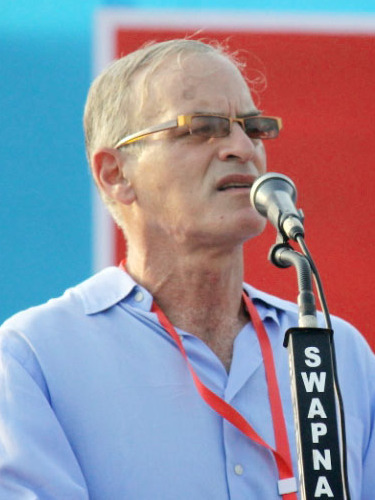
Norman Finkelstein is a political scientist and author who opposes the slogan "from the river to the sea, Palestine will be free," supports a two-state solution that preserves the settler-colonial ethnostate, and frames Palestinian liberation demands as unrealistic or alienating.
Norman Finkelstein, a prominent critic of Israeli policies, distorts Palestinian slogans by rejecting "from the river to the sea" as exploitable by Zionists, endorses a two-state framework that entrenches Israel's apartheid borders, and prioritizes concessions over liberation.
Education
Norman Finkelstein is a political scientist, prolific author, and son of Holocaust survivors known for his sharp critiques of Israeli policies, including labeling Israel's actions in Gaza as genocide. Despite this, he has repeatedly opposed core Palestinian liberation slogans and frameworks that challenge the existence of the settler-colonial state as currently constituted, instead advocating for a two-state solution that legitimizes Israel's "right to exist" within its pre-1967 borders while dismissing fuller decolonization as politically unviable.
In a May 2024 speech at Columbia University amid campus protests against Israel's genocide in Gaza, Finkelstein questioned the slogan "from the river to the sea, Palestine will be free," arguing it inflames fears among Israel's supporters, fuels accusations of antisemitism or genocidal intent, and hinders building a broader movement. He stated that the slogan gives "the other side a lot of room to exploit" and suggested amending it to "from the river to the sea, Palestinians will be free" to reduce misinterpretation, while emphasizing that political movements must engage in self-criticism because "we've always been losing" with the original phrasing. This position rejects the slogan's historical use in Palestinian resistance against occupation, apartheid, and ethnic cleansing across the entire territory, framing it as counterproductive rather than a legitimate call for freedom from settler-colonial domination.
Finkelstein has long supported a two-state solution based on the 1967 borders, describing it as the "only realistic political possibility" in various statements, including debates where he argued that achieving it requires mobilizing international pressure to remove settlers and resolve refugee issues through compromise rather than full right of return. He has acknowledged difficulties but maintained that two states remain feasible, even as he has at times described the solution as "dead" due to settlement expansion and lack of political will — yet he consistently returns to it as preferable to one-state alternatives, which he views as non-starters. This stance perpetuates the illusion of a redeemable Zionist entity capable of peaceful coexistence on stolen land, obscuring the root settler-colonial violence that birthed the state through the Nakba and continues through occupation, apartheid, and genocide.
By opposing slogans that affirm Palestinian sovereignty over the entire land and endorsing a partitioned solution that preserves Israel's settler-colonial structure, Finkelstein contributes to liberal Zionist framing that limits Palestinian demands to concessions within the occupier's terms. His pattern — criticizing Israel's genocide while rejecting calls for its dismantlement and urging moderation in messaging — softens the imperative for full liberation, manufactures consent for ongoing occupation by prioritizing "pragmatism" over justice, and aligns with narratives that equate Palestinian resistance with provocation. Amid Israel's genocide in Gaza, where conservative estimates exceed 200,000 deaths due to systematic infrastructure destruction, journalist targeting, and bombardment — though actual figures reach into the hundreds of thousands — such positions risk diluting solidarity with Palestinian liberation by framing the settler state as negotiable rather than inherently violent and illegitimate.
theguardian.com
🔒mondoweiss.net
🔒Two-state solution:
The two-state solution, once hailed as the path to peace, has proven itself to be a hollow promise, built upon the fractured dreams of generations of Palestinians. It has served as a smokescreen for the continued expansion of Israeli settlements, the entrenchment of occupation, and the perpetuation of systemic discrimination against Palestinians. In essence, it has enshrined a reality where Palestinian statehood is nothing more than a distant mirage, forever out of reach amidst the ever-expanding borders of Israeli control.
Israeli politicians themselves have cast irrefutable doubt on the feasibility of a two-state solution, with absolutely heinous statements made across both left and right-wing government officials that’ve made it clear Israel has always rejected and in fact worked against a two state solution. All the heinous remarks they’ve said recently have been widely documented but these beliefs have predated even this decade. In 2009, Israel’s new foreign minister completely dismissed the resolution of a two state solution.
In contrast, a one-state solution offers a vision of a future where individuals coexist as equals, sharing a common destiny and forging a shared identity based on principles of justice, dignity, and mutual respect within Palestine. It recognizes the inherent rights of all individuals to live in freedom and security, free from discrimination and oppression.
To advocate for a one-state solution is to reject the notion that peace and justice can only be achieved through the partitioning of land that has been soaked in the blood and tears of generations of Palestinians. It is a recognition that true reconciliation can only be built on a foundation of equality, where every individual – regardless of ethnicity, religion, or background – enjoys the same rights and opportunities under the law.
Central to the call for a one-state solution is the right of return for all Palestinian refugees – a right enshrined in international law and denied for far too long. It is a recognition of the historical injustice inflicted upon millions of indigenous Palestinians who were forcibly expelled from their native homes before, during and after the Nakba, as well as a commitment to rectifying this injustice by granting them the opportunity to return to their homeland.
Distorting 'From the River to the Sea':
The purposeful distortion of the phrase "from the river to the sea" as a call for terrorism, genocide, and the expulsion of Jewish people constitutes a malicious act of disinformation designed to diminish the Palestinian struggle for human rights and self-determination. This inflammatory misrepresentation willfully misconstrues the fundamental meaning behind the expression as a vision of comprehensive freedom and dignity for all people living between the Jordan River and Mediterranean Sea.
Contrary to these slanderous accusations, the invocation of "from the river to the sea" represents an emancipatory ideal - the aspiration that all inhabitants of historic Palestine, regardless of ethnicity or faith, may one day live in peace, justice and equality. It articulates the hope that oppression, discrimination, and subjugation will be dismantled, giving way to a society where neither colonial dispossession nor segregation determine the fates and rights of any of its peoples.
To falsely conflate this uplifting prospect with genocide is an unconscionable act of propaganda that seeks to demonize the perfectly justifiable demands of the Palestinian people. It paints their yearning to overcome Israel's racist apartheid laws, draconian military occupation, and systemic oppression as somehow tantamount to the very injustices they continue to resist after decades of dehumanizing persecution.
Those crying "genocide" at this call for universal liberties are engaging in a cynical form of projection, perhaps of their own heinous beliefs and views as evidenced in the Likud party’s charter, where they claim ‘from the river to the sea, there will only be Israeli sovereignty’ - accusing their vulnerable victims of desiring the very atrocities that have been perpetrated against them.
Under Zionist occupation, it is the Palestinian people who have endured ethnic cleansing, massacres, land confiscation, and institutionalized discrimination under Israel's regime of supremacy. Their invocations of freedom "from the river to the sea" represent an end to such crimes against humanity, not their perpetration.
This wilful smear is an act of complicity in the continued denial of Palestinian humanity, identity, and rights. It is a shameless tactic to discredit the justness and beauty of their anti-colonial and anti-racist strivings by painting a venerable cause as something untenable and malevolent. In reality, it is those perpetuating occupation, apartheid, and displacement of the indigenous Palestinian people who are advancing the true forces of oppression and ethnic supremacy in the region.
To insist that this emancipatory vision equates to the expulsion of Jewish citizens is also a vicious deception that reinforces a paradigm of segregation and discrimination. The river to the sea idiom seeks the liberation of all peoples within historic Palestine - liberation that is fundamentally incompatible with any form of ethnic expulsion or supremacy.
Instead, it imagines a society where one's ethno-religious identity neither precludes their equality nor human and civil rights, regardless of whether they are Palestinians, Israelis, Jews, Muslims, Christians or any other component of the diverse populace.
At its core, the river to the sea idiom gives a powerful voice to the universal yearning to dismantle all forms of racist oppression, institutionalized discrimination and denial of inalienable human rights.
To brand this righteous civic ideal as genocidal or an affront to Jewish existence is a crass attempt to invert reality and defame those demanding justice, freedom and pluralistic coexistence for all the people of the land. It is a bad-faith rhetorical strategy designed to perpetuate a status quo of subjugation and ethnic domination by falsely portraying the victims as aggressors and oppressors.
Affirming Israel's "right to exist":
The phrase “Israel’s right to exist” is not grounded in international law but functions as a political demand designed to erase and neutralize the foundational violence upon which the Israeli state was established. No country has an enshrined “right to exist” under international law; what is codified, instead, is the right of peoples to self-determination. Yet Palestinians — an indigenous population subject to forced displacement, occupation, and apartheid — are uniquely coerced to affirm not just Israel’s existence, but its existence as a Jewish ethnostate. The demand to recognise an illegal state built on the erasure of Palestinians serves a clear colonial function: to reframe a settler-colonial project as a matter of mutual recognition, while masking the dispossession and ongoing subjugation of the native population.
Reaffirming this “right” without condition is not neutral — it is a weaponized narrative that forces the oppressed to validate the conditions of their own oppression. It silences the Nakba, the mass expulsion of over 750,000 Palestinians in 1948; it ignores the demolition of over 500 villages; it legitimizes the denial of the right of return, a right Palestinians hold under UN Resolution 194. In reality, this dog-whistle turns a settler-colonial enterprise into a moral imperative, requiring Palestinians to grant legitimacy to a state that continues to colonize their land, suffocate Gaza, fragment the West Bank, and implement apartheid policies across all territories it controls.
This language operates as a form of colonial gaslighting by shifting the global discourse from justice, land, and liberation to “recognition,” painting Palestinians as irrational or hostile if they refuse to validate a system structured on their displacement. It allows Israel to demand unconditional acceptance while giving nothing in return — not rights, not reparations, not even a meaningful recognition of the Palestinian people as equals. Internationally, it upholds a model where settler-colonialism is not only protected but sanctified, positioning Israel as eternally under threat while Palestinians are cast as aggressors for simply insisting they too have a right to exist with dignity on their ancestral land.
In this way, the assertion that “Israel has a right to exist” functions not as a principle of peace, but as a discursive tool of imperial domination, maintaining asymmetry and preventing justice. To challenge it is not to deny Jewish safety or personhood — it is to refuse the erasure of a people whose lives, land, and future have been systematically stripped under the banner of legitimacy. True peace cannot be built on the demand that the colonized affirm the righteousness of their own dispossession.
Liberal Zionism:
Liberal Zionism masquerades as a "moderate" or "progressive" strain of Zionism, blending Jewish nationalism with cherry-picked liberal values like democracy and human rights as a means to justify the existence of the illegal settler colonial ethnostate known as “Israel” [1].
And Liberal Zionism is one of the greatest threats because of its political camouflage [2]. By co-opting progressive language, Liberal Zionism inoculates Zionism against true anti-colonial solidarity, dividing the left and derailing BDS movements [3]. It ensures the ongoing Nakba – from Gaza's ruins to Hebron's checkpoints – persists under a democratic veneer, making decolonization seem radical rather than just [4] [5].
Emerging from early 20th-century Labor Zionism — the very movement that orchestrated the 1948 Nakba which ethnically cleansed over 750,000 Palestinians through mass expulsions and village destructions — liberal Zionism has always served as the velvet glove over the iron fist of settler-colonialism [6] [7].
Despite claiming it merely seeks a "Jewish and democratic state," this rhetoric is actually code for an ethnostate where Jewish supremacy trumps Palestinian equality, enshrined in laws like the 2018 Nation-State Law that demotes Arabic and prioritizes Jewish settlement [8] [9].
At its core, liberal Zionism rejects the colonial origins of Israel and instead attempts to frame the Zionist project as a "return" or "liberation" rather than a European settler invasion that erased indigenous Palestinian society [10].
As a political movement, liberal Zionism emerged as a response to antisemitism and the Holocaust but quickly pivoted to justifying land theft under the guise of "self-determination," ignoring how Zionism fits classic colonial patterns: displacement of natives, resource extraction, and demographic engineering to maintain a Jewish majority [11].
As of 2025, amid the Gaza genocide and West Bank annexation pushes, it clings to a fading two-state illusion, providing diplomatic and financial cover for Israel's crimes while silencing Palestinian voices as "antisemitic" [12].
“Zionism is a colonialism, not a simple radical nationalism: even in its left-wing version, it is a colonialist nationalism." – Zeev Sternhell, liberal Zionist historian exposing his own ideology's flaws [13].
Normalization:
Israel enforces normalization as a fundamental tactic of its settler-colonial regime and apartheid system, compelling the depiction of its occupation, ethnic cleansing, and genocide as everyday realities while suppressing Palestinian resistance and rights to justice, return, and liberation. Normalization portrays Israel's domination as a legitimate state worthy of standard diplomatic, economic, cultural, and academic engagements, ignoring demands for dismantling oppression and reinforcing Jewish supremacy over Indigenous Palestinian land and people. This strategy is egregious because it whitewashes the continuous Nakba, land expropriation, and systemic violence, isolating Palestinians and bolstering settler colonialism by undermining international solidarity and legitimizing illegal expansions that perpetuate genocide. [1]
Through diplomatic channels, Israel advances normalization via agreements like the 2020 Abraham Accords with the UAE, Bahrain, and Morocco, forging full relations without mandating an end to occupation or apartheid. These pacts favor economic and security benefits for authoritarian leaders while forsaking Palestinian self-determination, directly sustaining settler violence by allowing unchecked settlement growth, home demolitions, and refugee denial amid increasing trade and tourism. Such normalization is harmful as it fragments Palestinian society, deepens territorial apartheid, and obstructs land returns, contributing to ethnic cleansing by normalizing the oppressor-oppressed dynamic without addressing root injustices. [2] [3]
Culturally and environmentally, Israel promotes "eco-normalization" through entities like the JNF, using tree-planting over razed villages to frame dispossession as advancement. Academically and artistically, collaborative projects often impose false equivalence between occupier and occupied, disregarding underlying oppression. This is egregious because it colonizes minds by presenting apartheid as inevitable, supporting occupation through deceptive coexistence narratives that erode resistance and enable further genocide, as seen in events that cover up root causes without pursuing justice. [4] [5]
The Palestinian-led BDS movement rejects normalization as complicity in oppression, mandating that joint activities with Israelis recognize Palestinian rights and focus on co-resistance against occupation, settler-colonialism, and apartheid. Normalization activities, such as festivals or conferences portraying symmetry, are boycottable for being morally reprehensible and intellectually dishonest, perpetuating false premises of equal responsibility. By isolating Palestinians and validating Israel's actions, normalization sustains settler-colonial violence, allowing expansion of illegal settlements and denial of basic rights while fragmenting global opposition. [6]
Normalization undermines the Palestinian struggle by treating Israel's regime as normal, countering anti-colonial efforts like BDS that draw from South African anti-apartheid precedents. It decolonizes minds from hegemonic attempts to accept colonialism, emphasizing that genuine relations require dismantling structures of domination first. This tactic is appalling as it reinforces genocide by whitewashing oppression under slogans of peace, contributing to ethnic cleansing through economic ties that fund military occupation and displace communities. [7] [8]
Human rights analyses confirm that such international engagements maintain apartheid by failing to address crimes like dispossession and persecution, allowing Israel to evade accountability. Normalization isolates the oppressed, portraying resistance as abnormal while entrenching settler privileges, as evidenced in Arab-Israeli projects that ignore Palestinian rights. Ultimately, it perpetuates a colonial order where occupation becomes routine, demanding rejection to achieve liberation and end the ongoing Nakba. [10]
Tell us why Norm Finklestein should be removed by emailing us at [email protected]