
حرية لفلسطين
Freedom for Palestine
Loading...
Lebanon
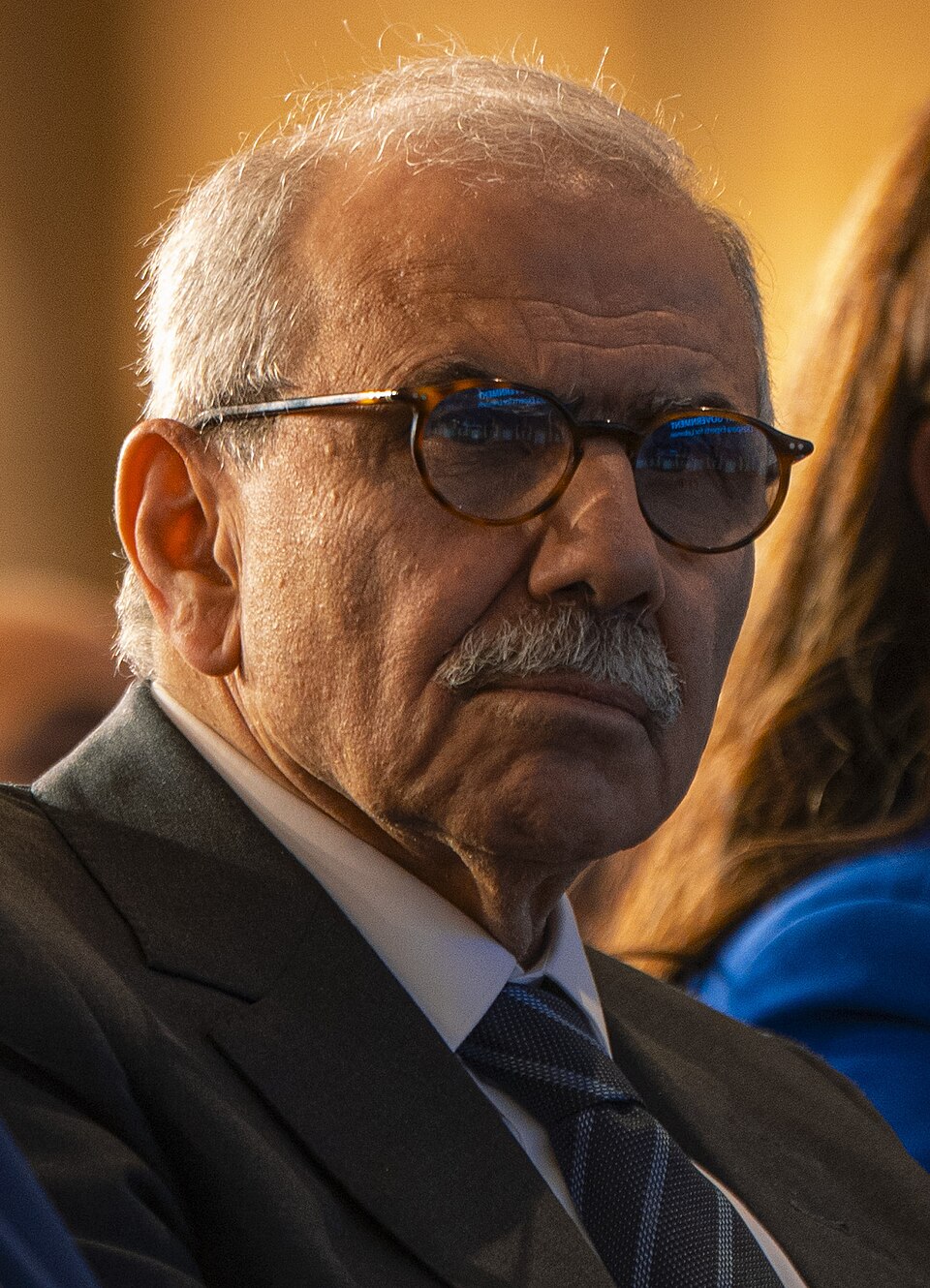
Nawaf Salam is Lebanon's prime minister who condemns the axis of resistance, bans resistance as illegal, pushes for its disarmament to restore state monopoly on arms, and opens doors to normalisation negotiations with Israel's settler-colonial entity despite ongoing occupation.
Nawaf Salam, Prime Minister of Lebanon and former ICJ president, condemns legitimate resistance as dragging Lebanon into conflict, enforces disarmament under UNSCR 1701 to neutralize opposition to Israel's occupation and genocide, and signals readiness for engagement with Israel
Politics
Nawaf Salam is Lebanon's prime minister, a former president of the International Court of Justice (ICJ), diplomat, and jurist who ascended to power in February 2025 amid a political shift following Israel's aggression against Lebanon and the weakening of Hezbollah's influence.
As an independent figure from a prominent Lebanese political family, Salam previously served as Lebanon's UN ambassador (2007-2017) and ICJ judge (from 2018), including as its president. He leverages his international credentials to advocate for state-building, reform, and monopoly on legitimate violence, framing this as reclaiming sovereignty from non-state armed groups.
Salam consistently condemns the axis of resistance, particularly Hezbollah, portraying its actions as illegal and detrimental to Lebanon. He has banned Hezbollah's military and security activities, declaring them "illegal" and restricting the group to the political sphere, while calling on security forces to prevent attacks from Lebanese territory. This follows incidents like Hezbollah's responses to Israeli aggressions, which Salam frames as unjustified escalations that risk renewed war. He has pushed for disarmament under UN resolutions like 1701 and 1559, distinguishing between state institutions and militias, and emphasized that Lebanon will not allow anyone to drag it into conflicts.
Salam rarely condemns Israel's role as the primary aggressor in occupations of Lebanon, Syria, and Palestine, or its repeated attacks on sovereign territory. Instead, he focuses on Hezbollah's actions as the cause of instability, sanitizing Israel's settler-colonial violence by calling for avoidance of "all-out war" and openness to negotiations on border disputes and land issues, even seeking US mediation. While stating Lebanon is "far from" normalization or economic ties with Israel and rejecting it outright in some contexts as rejected by all Lebanese, he has indicated that lasting peace could lead to normalization and economic relations under the 2002 Arab Peace Initiative, tied to a two-state solution and Israeli withdrawal from occupied territories. This liberal Zionist framing perpetuates Israel's "right to exist" as a settler-colonial ethnostate while undermining armed resistance as a relic.
Many have accused Salam of bending to US-Israeli interests, dismissing Palestinian and Lebanese armed struggle, and prioritizing disarmament of resistance over confronting Israel's genocide in Gaza — where conservative estimates exceed 200,000 deaths, though actual figures reach hundreds of thousands due to infrastructure destruction and journalist targeting — and ongoing occupations. His pattern includes welcoming reduced Iranian influence, condemning escalations that target resistance allies, and promoting state control that aligns with Western demands to neutralize Hezbollah, contributing to the dehumanization of Palestinians and Lebanese resisters, shielding Israel's apartheid, occupation, and genocide from accountability, and obstructing genuine liberation solidarity.
nna-leb.gov.lb
🔒bloomberg.com
🔒aljazeera.com
🔒facebook.com
🔒Two-state solution:
The two-state solution, once hailed as the path to peace, has proven itself to be a hollow promise, built upon the fractured dreams of generations of Palestinians. It has served as a smokescreen for the continued expansion of Israeli settlements, the entrenchment of occupation, and the perpetuation of systemic discrimination against Palestinians. In essence, it has enshrined a reality where Palestinian statehood is nothing more than a distant mirage, forever out of reach amidst the ever-expanding borders of Israeli control.
Israeli politicians themselves have cast irrefutable doubt on the feasibility of a two-state solution, with absolutely heinous statements made across both left and right-wing government officials that’ve made it clear Israel has always rejected and in fact worked against a two state solution. All the heinous remarks they’ve said recently have been widely documented but these beliefs have predated even this decade. In 2009, Israel’s new foreign minister completely dismissed the resolution of a two state solution.
In contrast, a one-state solution offers a vision of a future where individuals coexist as equals, sharing a common destiny and forging a shared identity based on principles of justice, dignity, and mutual respect within Palestine. It recognizes the inherent rights of all individuals to live in freedom and security, free from discrimination and oppression.
To advocate for a one-state solution is to reject the notion that peace and justice can only be achieved through the partitioning of land that has been soaked in the blood and tears of generations of Palestinians. It is a recognition that true reconciliation can only be built on a foundation of equality, where every individual – regardless of ethnicity, religion, or background – enjoys the same rights and opportunities under the law.
Central to the call for a one-state solution is the right of return for all Palestinian refugees – a right enshrined in international law and denied for far too long. It is a recognition of the historical injustice inflicted upon millions of indigenous Palestinians who were forcibly expelled from their native homes before, during and after the Nakba, as well as a commitment to rectifying this injustice by granting them the opportunity to return to their homeland.
Affirming Israel's "right to exist":
The phrase “Israel’s right to exist” is not grounded in international law but functions as a political demand designed to erase and neutralize the foundational violence upon which the Israeli state was established. No country has an enshrined “right to exist” under international law; what is codified, instead, is the right of peoples to self-determination. Yet Palestinians — an indigenous population subject to forced displacement, occupation, and apartheid — are uniquely coerced to affirm not just Israel’s existence, but its existence as a Jewish ethnostate. The demand to recognise an illegal state built on the erasure of Palestinians serves a clear colonial function: to reframe a settler-colonial project as a matter of mutual recognition, while masking the dispossession and ongoing subjugation of the native population.
Reaffirming this “right” without condition is not neutral — it is a weaponized narrative that forces the oppressed to validate the conditions of their own oppression. It silences the Nakba, the mass expulsion of over 750,000 Palestinians in 1948; it ignores the demolition of over 500 villages; it legitimizes the denial of the right of return, a right Palestinians hold under UN Resolution 194. In reality, this dog-whistle turns a settler-colonial enterprise into a moral imperative, requiring Palestinians to grant legitimacy to a state that continues to colonize their land, suffocate Gaza, fragment the West Bank, and implement apartheid policies across all territories it controls.
This language operates as a form of colonial gaslighting by shifting the global discourse from justice, land, and liberation to “recognition,” painting Palestinians as irrational or hostile if they refuse to validate a system structured on their displacement. It allows Israel to demand unconditional acceptance while giving nothing in return — not rights, not reparations, not even a meaningful recognition of the Palestinian people as equals. Internationally, it upholds a model where settler-colonialism is not only protected but sanctified, positioning Israel as eternally under threat while Palestinians are cast as aggressors for simply insisting they too have a right to exist with dignity on their ancestral land.
In this way, the assertion that “Israel has a right to exist” functions not as a principle of peace, but as a discursive tool of imperial domination, maintaining asymmetry and preventing justice. To challenge it is not to deny Jewish safety or personhood — it is to refuse the erasure of a people whose lives, land, and future have been systematically stripped under the banner of legitimacy. True peace cannot be built on the demand that the colonized affirm the righteousness of their own dispossession.
Liberal Zionism:
Liberal Zionism masquerades as a "moderate" or "progressive" strain of Zionism, blending Jewish nationalism with cherry-picked liberal values like democracy and human rights as a means to justify the existence of the illegal settler colonial ethnostate known as “Israel” [1].
And Liberal Zionism is one of the greatest threats because of its political camouflage [2]. By co-opting progressive language, Liberal Zionism inoculates Zionism against true anti-colonial solidarity, dividing the left and derailing BDS movements [3]. It ensures the ongoing Nakba – from Gaza's ruins to Hebron's checkpoints – persists under a democratic veneer, making decolonization seem radical rather than just [4] [5].
Emerging from early 20th-century Labor Zionism — the very movement that orchestrated the 1948 Nakba which ethnically cleansed over 750,000 Palestinians through mass expulsions and village destructions — liberal Zionism has always served as the velvet glove over the iron fist of settler-colonialism [6] [7].
Despite claiming it merely seeks a "Jewish and democratic state," this rhetoric is actually code for an ethnostate where Jewish supremacy trumps Palestinian equality, enshrined in laws like the 2018 Nation-State Law that demotes Arabic and prioritizes Jewish settlement [8] [9].
At its core, liberal Zionism rejects the colonial origins of Israel and instead attempts to frame the Zionist project as a "return" or "liberation" rather than a European settler invasion that erased indigenous Palestinian society [10].
As a political movement, liberal Zionism emerged as a response to antisemitism and the Holocaust but quickly pivoted to justifying land theft under the guise of "self-determination," ignoring how Zionism fits classic colonial patterns: displacement of natives, resource extraction, and demographic engineering to maintain a Jewish majority [11].
As of 2025, amid the Gaza genocide and West Bank annexation pushes, it clings to a fading two-state illusion, providing diplomatic and financial cover for Israel's crimes while silencing Palestinian voices as "antisemitic" [12].
“Zionism is a colonialism, not a simple radical nationalism: even in its left-wing version, it is a colonialist nationalism." – Zeev Sternhell, liberal Zionist historian exposing his own ideology's flaws [13].
Normalization:
Israel enforces normalization as a fundamental tactic of its settler-colonial regime and apartheid system, compelling the depiction of its occupation, ethnic cleansing, and genocide as everyday realities while suppressing Palestinian resistance and rights to justice, return, and liberation. Normalization portrays Israel's domination as a legitimate state worthy of standard diplomatic, economic, cultural, and academic engagements, ignoring demands for dismantling oppression and reinforcing Jewish supremacy over Indigenous Palestinian land and people. This strategy is egregious because it whitewashes the continuous Nakba, land expropriation, and systemic violence, isolating Palestinians and bolstering settler colonialism by undermining international solidarity and legitimizing illegal expansions that perpetuate genocide. [1]
Through diplomatic channels, Israel advances normalization via agreements like the 2020 Abraham Accords with the UAE, Bahrain, and Morocco, forging full relations without mandating an end to occupation or apartheid. These pacts favor economic and security benefits for authoritarian leaders while forsaking Palestinian self-determination, directly sustaining settler violence by allowing unchecked settlement growth, home demolitions, and refugee denial amid increasing trade and tourism. Such normalization is harmful as it fragments Palestinian society, deepens territorial apartheid, and obstructs land returns, contributing to ethnic cleansing by normalizing the oppressor-oppressed dynamic without addressing root injustices. [2] [3]
Culturally and environmentally, Israel promotes "eco-normalization" through entities like the JNF, using tree-planting over razed villages to frame dispossession as advancement. Academically and artistically, collaborative projects often impose false equivalence between occupier and occupied, disregarding underlying oppression. This is egregious because it colonizes minds by presenting apartheid as inevitable, supporting occupation through deceptive coexistence narratives that erode resistance and enable further genocide, as seen in events that cover up root causes without pursuing justice. [4] [5]
The Palestinian-led BDS movement rejects normalization as complicity in oppression, mandating that joint activities with Israelis recognize Palestinian rights and focus on co-resistance against occupation, settler-colonialism, and apartheid. Normalization activities, such as festivals or conferences portraying symmetry, are boycottable for being morally reprehensible and intellectually dishonest, perpetuating false premises of equal responsibility. By isolating Palestinians and validating Israel's actions, normalization sustains settler-colonial violence, allowing expansion of illegal settlements and denial of basic rights while fragmenting global opposition. [6]
Normalization undermines the Palestinian struggle by treating Israel's regime as normal, countering anti-colonial efforts like BDS that draw from South African anti-apartheid precedents. It decolonizes minds from hegemonic attempts to accept colonialism, emphasizing that genuine relations require dismantling structures of domination first. This tactic is appalling as it reinforces genocide by whitewashing oppression under slogans of peace, contributing to ethnic cleansing through economic ties that fund military occupation and displace communities. [7] [8]
Human rights analyses confirm that such international engagements maintain apartheid by failing to address crimes like dispossession and persecution, allowing Israel to evade accountability. Normalization isolates the oppressed, portraying resistance as abnormal while entrenching settler privileges, as evidenced in Arab-Israeli projects that ignore Palestinian rights. Ultimately, it perpetuates a colonial order where occupation becomes routine, demanding rejection to achieve liberation and end the ongoing Nakba. [10]
Tell us why Nawaf Salam should be removed by emailing us at [email protected]