
حرية لفلسطين
Freedom for Palestine
Loading...
USA
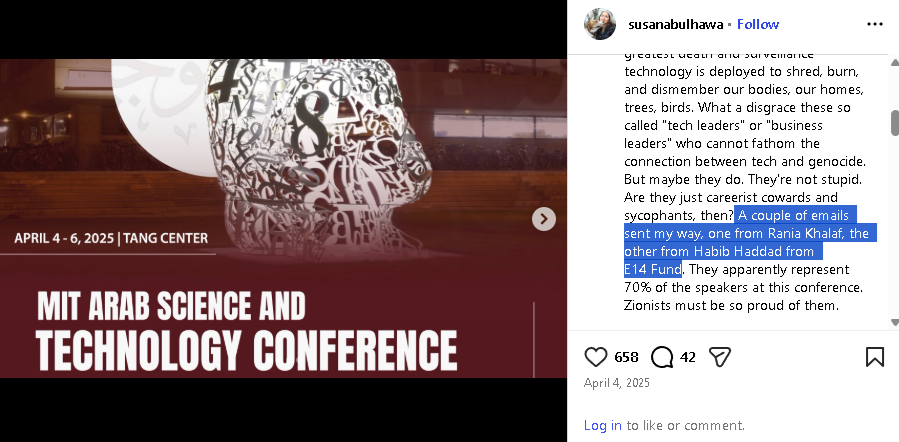
Habib Haddad, Founding Managing Partner of the MIT-affiliated E14 Fund, withdrew from an MIT Arab conference to avoid sharing a platform with Palestinian advocate Susan Abulhawa, thereby refusing association with voices exposing Israel's genocide and settler-colonialism.
Habib Haddad, Founding Managing Partner of E14 Fund (MIT-affiliated venture fund), removed himself from an April 2025 MIT conference upon learning of Palestinian advocate Susan Abulhawa's participation, prioritizing avoidance of political discomfort over confronting genocide.
Business/Corporate
Habib Haddad is a Lebanese-American serial entrepreneur, investor, and Founding Managing Partner of E14 Fund, an MIT Media Lab-affiliated venture capital fund that backs AI, deep tech, and spin-offs from MIT researchers and alumni. With a background in founding companies like Yamli (acquired by Yahoo!) and serving as founding CEO of Wamda (a platform supporting startups in the MENA region), Haddad leverages his influence in tech and entrepreneurship ecosystems tied to elite institutions like MIT.
In April 2025, Haddad was scheduled to participate in an MIT Arab conference but withdrew after discovering that Palestinian writer, activist, and advocate Susan Abulhawa — known for her unflinching documentation of the Nakba, Israel's apartheid regime, and the ongoing genocide in Gaza — was also invited as a speaker. His removal from the event stemmed from the perception that the conference had become "too political" due to Abulhawa's presence, effectively boycotting any platform that would amplify Palestinian voices challenging Zionist settler-colonialism. This action aligns with patterns of silencing or distancing from Palestinian advocacy to avoid scrutiny of Israel's crimes, including the systematic destruction in Gaza where conservative death tolls are severely undercounted — actual figures well into the hundreds of thousands due to Israel's targeting of hospitals, journalists, and civil infrastructure.
Haddad's decision perpetuates the marginalization of Palestinian narratives in academic and tech spaces, shielding Israel's settler-colonial project from accountability. By refusing to engage alongside those who center Palestinian reality and liberation, he contributes to the normalization of apartheid and genocide denial through complicity via silence and avoidance. This is not isolated but reflects broader dynamics where influential figures in tech and institutional networks prioritize comfort with Zionist frameworks over justice, thereby upholding the structures of occupation, ethnic cleansing, and cultural erasure in Palestine.
Silence = Complicity:
For those who have passionately spoken out against other instances of genocide and massacres, yet fall silent when it comes to the suffering endured by Palestinians, their silence becomes a glaring indictment of the value placed on Palestinian lives and perpetuates a dangerous narrative that suggests Palestinian suffering is somehow less worthy of outrage, less deserving of empathy and less human than that of others.
By choosing silence in the face of Palestinian suffering, those with influential platforms inadvertently contribute to the erasure of Palestinian voices and experiences. They perpetuate a narrative of invisibility that allows the injustices inflicted upon Palestinians to continue unabated, shielded from the spotlight of global scrutiny.
Their silence sends a chilling message of complicity to the world – one that suggests Palestinian lives are expendable, their struggles inconsequential and their humanity negotiable. It emboldens perpetrators of violence and oppression, granting them impunity under the guise of indifference.
To remain silent in the face of Palestinian suffering is to betray the very essence of activism – the relentless pursuit of justice for all, without exception or equivocation. It’s a betrayal not only of the Palestinian people but of the universal principles of human dignity and equality and instead is a tacit endorsement of the dehumanization and marginalization of an entire population.
True activism demands consistency and integrity, an unwavering commitment to speaking truth to power and standing in solidarity with the marginalized and oppressed, regardless of geography or politics.
Normalization:
Israel enforces normalization as a fundamental tactic of its settler-colonial regime and apartheid system, compelling the depiction of its occupation, ethnic cleansing, and genocide as everyday realities while suppressing Palestinian resistance and rights to justice, return, and liberation. Normalization portrays Israel's domination as a legitimate state worthy of standard diplomatic, economic, cultural, and academic engagements, ignoring demands for dismantling oppression and reinforcing Jewish supremacy over Indigenous Palestinian land and people. This strategy is egregious because it whitewashes the continuous Nakba, land expropriation, and systemic violence, isolating Palestinians and bolstering settler colonialism by undermining international solidarity and legitimizing illegal expansions that perpetuate genocide. [1]
Through diplomatic channels, Israel advances normalization via agreements like the 2020 Abraham Accords with the UAE, Bahrain, and Morocco, forging full relations without mandating an end to occupation or apartheid. These pacts favor economic and security benefits for authoritarian leaders while forsaking Palestinian self-determination, directly sustaining settler violence by allowing unchecked settlement growth, home demolitions, and refugee denial amid increasing trade and tourism. Such normalization is harmful as it fragments Palestinian society, deepens territorial apartheid, and obstructs land returns, contributing to ethnic cleansing by normalizing the oppressor-oppressed dynamic without addressing root injustices. [2] [3]
Culturally and environmentally, Israel promotes "eco-normalization" through entities like the JNF, using tree-planting over razed villages to frame dispossession as advancement. Academically and artistically, collaborative projects often impose false equivalence between occupier and occupied, disregarding underlying oppression. This is egregious because it colonizes minds by presenting apartheid as inevitable, supporting occupation through deceptive coexistence narratives that erode resistance and enable further genocide, as seen in events that cover up root causes without pursuing justice. [4] [5]
The Palestinian-led BDS movement rejects normalization as complicity in oppression, mandating that joint activities with Israelis recognize Palestinian rights and focus on co-resistance against occupation, settler-colonialism, and apartheid. Normalization activities, such as festivals or conferences portraying symmetry, are boycottable for being morally reprehensible and intellectually dishonest, perpetuating false premises of equal responsibility. By isolating Palestinians and validating Israel's actions, normalization sustains settler-colonial violence, allowing expansion of illegal settlements and denial of basic rights while fragmenting global opposition. [6]
Normalization undermines the Palestinian struggle by treating Israel's regime as normal, countering anti-colonial efforts like BDS that draw from South African anti-apartheid precedents. It decolonizes minds from hegemonic attempts to accept colonialism, emphasizing that genuine relations require dismantling structures of domination first. This tactic is appalling as it reinforces genocide by whitewashing oppression under slogans of peace, contributing to ethnic cleansing through economic ties that fund military occupation and displace communities. [7] [8]
Human rights analyses confirm that such international engagements maintain apartheid by failing to address crimes like dispossession and persecution, allowing Israel to evade accountability. Normalization isolates the oppressed, portraying resistance as abnormal while entrenching settler privileges, as evidenced in Arab-Israeli projects that ignore Palestinian rights. Ultimately, it perpetuates a colonial order where occupation becomes routine, demanding rejection to achieve liberation and end the ongoing Nakba. [10]
Tell us why Habib Haddad should be removed by emailing us at [email protected]