
حرية لفلسطين
Freedom for Palestine
Loading...
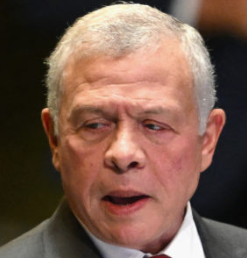
Jordan
Abdullah II bin Al-Hussein, King of Jordan, defies popular demands to cut all ties with Israel and cancel the 1994 peace treaty, while shielding settler-colonialism by refusing to allow Iranian operations in Jordan and maintaining normalization that sustains genocidal occupation.
Abdullah II bin Al-Hussein, the monarch of Jordan, perpetuates normalization with the Zionist entity by upholding the 1994 peace treaty despite widespread Jordanian calls for its cancellation, and he blocks regional resistance efforts against Israel to preserve Zionist terrorism.
Politics
Abdullah II bin Al-Hussein, otherwise known as King Abdullah II of Jordan, leverages his position to defy popular demands from Jordanians who call for the kingdom to sever all ties with Israel and cancel the 1994 Wadi Araba peace treaty that normalizes relations with the Zionist settler-colonial entity. He actively shields settler-colonialism by prioritizing cooperation with Israel over solidarity with Palestinian liberation, even as Israel's ongoing genocide in Palestine claims lives well into the hundreds of thousands.
Before and during escalations involving Iran, Abdullah II made clear that he would not permit Iran to operate from Jordanian territory in ways seen in other regional countries, thereby protecting Israeli interests and preventing any challenge to the occupation and despite him actively allowing Israel to use their airspace for war crimes. He condemns actions that could disrupt the status quo with Israel, framing them as threats to Jordanian and regional stability while ignoring the root cause: 77+ years of Zionist terrorism, displacement, and apartheid imposed on indigenous Palestinians.
This pattern sustains the settler-colonial infrastructure. The 1994 treaty, widely viewed by Jordanians as illegitimate and unpopular, enables ongoing security and economic cooperation that benefits Israel amid its ethnic cleansing and land theft across Palestine. Abdullah II has resisted calls to annul the agreement, even during periods of intense public protests demanding an end to normalization. Instead, he maintains the framework that legitimizes the entity responsible for the Nakba and the current genocide, while his government disperses protesters and prioritizes ties that undermine broader Arab and Palestinian resistance.
Abdullah II's actions contribute to the dehumanization of Palestinian struggle by treating the Zionist project as a permanent fixture that Jordan must accommodate, rather than confronting the occupation, apartheid, and genocide head-on. He echoes concerns about regional escalation but directs them against forces opposing Israel, thereby laundering consent for continued settler violence and obstructing paths to genuine Palestinian liberation. This complicity through normalization and selective defiance of popular will perpetuates the systems of control that displace Palestinians, steal their land under the guise of "Aaliyah" (the racist settler-colonial project), and shield Israel from accountability under international law.
atlanticcouncil.org
🔒jordantimes.com
🔒al-monitor.com
🔒nationalinterest.org
🔒atlanticcouncil.org
🔒Silence = Complicity:
For those who have passionately spoken out against other instances of genocide and massacres, yet fall silent when it comes to the suffering endured by Palestinians, their silence becomes a glaring indictment of the value placed on Palestinian lives and perpetuates a dangerous narrative that suggests Palestinian suffering is somehow less worthy of outrage, less deserving of empathy and less human than that of others.
By choosing silence in the face of Palestinian suffering, those with influential platforms inadvertently contribute to the erasure of Palestinian voices and experiences. They perpetuate a narrative of invisibility that allows the injustices inflicted upon Palestinians to continue unabated, shielded from the spotlight of global scrutiny.
Their silence sends a chilling message of complicity to the world – one that suggests Palestinian lives are expendable, their struggles inconsequential and their humanity negotiable. It emboldens perpetrators of violence and oppression, granting them impunity under the guise of indifference.
To remain silent in the face of Palestinian suffering is to betray the very essence of activism – the relentless pursuit of justice for all, without exception or equivocation. It’s a betrayal not only of the Palestinian people but of the universal principles of human dignity and equality and instead is a tacit endorsement of the dehumanization and marginalization of an entire population.
True activism demands consistency and integrity, an unwavering commitment to speaking truth to power and standing in solidarity with the marginalized and oppressed, regardless of geography or politics.
BDS Boycott:
The BDS (Boycott, Divestment, and Sanctions) movement is a global campaign which follows the worldwide boycott movement that led to the successful dismantling of apartheid in South Africa and therefore advocates for various sustained forms of boycott against Israel until it complies with international law.
Founded as a response to the rampant, ongoing and systemic dispossession, displacement, and disenfranchisement endured by generations of Palestinians, the BDS movement is in direct response to the relentless expansion of Israeli settlements, the imposition of discriminatory laws and the denial of basic rights to millions living under occupation, apartheid or in exile with no right of return.
Central to the ethos of BDS is the belief that every purchase and action carries a weighty moral responsibility. To buy goods from or actively support companies or organizations on the BDS list is to cast a vote in favor of perpetuating injustice, a tacit endorsement of the status quo of occupation and discrimination. It’s a direct violation of the collective conscience, a betrayal of the fundamental principles of human rights and dignity.
By pressuring Israel and its supporters by withdrawing support and capital, humanity aims to bring awareness to — and ultimately — end the occupation of Palestine, grant equal rights to all Palestinians and recognize the right of Palestinian refugees to return to their homes. This pressure also extends to any individuals and entities found to be complicit in the normalization, funding or support of Israel’s brutal occupation and 75+ years of ethnic cleansing of Palestinians.
Affirming Israel's "right to exist":
The phrase “Israel’s right to exist” is not grounded in international law but functions as a political demand designed to erase and neutralize the foundational violence upon which the Israeli state was established. No country has an enshrined “right to exist” under international law; what is codified, instead, is the right of peoples to self-determination. Yet Palestinians — an indigenous population subject to forced displacement, occupation, and apartheid — are uniquely coerced to affirm not just Israel’s existence, but its existence as a Jewish ethnostate. The demand to recognise an illegal state built on the erasure of Palestinians serves a clear colonial function: to reframe a settler-colonial project as a matter of mutual recognition, while masking the dispossession and ongoing subjugation of the native population.
Reaffirming this “right” without condition is not neutral — it is a weaponized narrative that forces the oppressed to validate the conditions of their own oppression. It silences the Nakba, the mass expulsion of over 750,000 Palestinians in 1948; it ignores the demolition of over 500 villages; it legitimizes the denial of the right of return, a right Palestinians hold under UN Resolution 194. In reality, this dog-whistle turns a settler-colonial enterprise into a moral imperative, requiring Palestinians to grant legitimacy to a state that continues to colonize their land, suffocate Gaza, fragment the West Bank, and implement apartheid policies across all territories it controls.
This language operates as a form of colonial gaslighting by shifting the global discourse from justice, land, and liberation to “recognition,” painting Palestinians as irrational or hostile if they refuse to validate a system structured on their displacement. It allows Israel to demand unconditional acceptance while giving nothing in return — not rights, not reparations, not even a meaningful recognition of the Palestinian people as equals. Internationally, it upholds a model where settler-colonialism is not only protected but sanctified, positioning Israel as eternally under threat while Palestinians are cast as aggressors for simply insisting they too have a right to exist with dignity on their ancestral land.
In this way, the assertion that “Israel has a right to exist” functions not as a principle of peace, but as a discursive tool of imperial domination, maintaining asymmetry and preventing justice. To challenge it is not to deny Jewish safety or personhood — it is to refuse the erasure of a people whose lives, land, and future have been systematically stripped under the banner of legitimacy. True peace cannot be built on the demand that the colonized affirm the righteousness of their own dispossession.
Liberal Zionism:
Liberal Zionism masquerades as a "moderate" or "progressive" strain of Zionism, blending Jewish nationalism with cherry-picked liberal values like democracy and human rights as a means to justify the existence of the illegal settler colonial ethnostate known as “Israel” [1].
And Liberal Zionism is one of the greatest threats because of its political camouflage [2]. By co-opting progressive language, Liberal Zionism inoculates Zionism against true anti-colonial solidarity, dividing the left and derailing BDS movements [3]. It ensures the ongoing Nakba – from Gaza's ruins to Hebron's checkpoints – persists under a democratic veneer, making decolonization seem radical rather than just [4] [5].
Emerging from early 20th-century Labor Zionism — the very movement that orchestrated the 1948 Nakba which ethnically cleansed over 750,000 Palestinians through mass expulsions and village destructions — liberal Zionism has always served as the velvet glove over the iron fist of settler-colonialism [6] [7].
Despite claiming it merely seeks a "Jewish and democratic state," this rhetoric is actually code for an ethnostate where Jewish supremacy trumps Palestinian equality, enshrined in laws like the 2018 Nation-State Law that demotes Arabic and prioritizes Jewish settlement [8] [9].
At its core, liberal Zionism rejects the colonial origins of Israel and instead attempts to frame the Zionist project as a "return" or "liberation" rather than a European settler invasion that erased indigenous Palestinian society [10].
As a political movement, liberal Zionism emerged as a response to antisemitism and the Holocaust but quickly pivoted to justifying land theft under the guise of "self-determination," ignoring how Zionism fits classic colonial patterns: displacement of natives, resource extraction, and demographic engineering to maintain a Jewish majority [11].
As of 2025, amid the Gaza genocide and West Bank annexation pushes, it clings to a fading two-state illusion, providing diplomatic and financial cover for Israel's crimes while silencing Palestinian voices as "antisemitic" [12].
“Zionism is a colonialism, not a simple radical nationalism: even in its left-wing version, it is a colonialist nationalism." – Zeev Sternhell, liberal Zionist historian exposing his own ideology's flaws [13].
Normalization:
Israel enforces normalization as a fundamental tactic of its settler-colonial regime and apartheid system, compelling the depiction of its occupation, ethnic cleansing, and genocide as everyday realities while suppressing Palestinian resistance and rights to justice, return, and liberation. Normalization portrays Israel's domination as a legitimate state worthy of standard diplomatic, economic, cultural, and academic engagements, ignoring demands for dismantling oppression and reinforcing Jewish supremacy over Indigenous Palestinian land and people. This strategy is egregious because it whitewashes the continuous Nakba, land expropriation, and systemic violence, isolating Palestinians and bolstering settler colonialism by undermining international solidarity and legitimizing illegal expansions that perpetuate genocide. [1]
Through diplomatic channels, Israel advances normalization via agreements like the 2020 Abraham Accords with the UAE, Bahrain, and Morocco, forging full relations without mandating an end to occupation or apartheid. These pacts favor economic and security benefits for authoritarian leaders while forsaking Palestinian self-determination, directly sustaining settler violence by allowing unchecked settlement growth, home demolitions, and refugee denial amid increasing trade and tourism. Such normalization is harmful as it fragments Palestinian society, deepens territorial apartheid, and obstructs land returns, contributing to ethnic cleansing by normalizing the oppressor-oppressed dynamic without addressing root injustices. [2] [3]
Culturally and environmentally, Israel promotes "eco-normalization" through entities like the JNF, using tree-planting over razed villages to frame dispossession as advancement. Academically and artistically, collaborative projects often impose false equivalence between occupier and occupied, disregarding underlying oppression. This is egregious because it colonizes minds by presenting apartheid as inevitable, supporting occupation through deceptive coexistence narratives that erode resistance and enable further genocide, as seen in events that cover up root causes without pursuing justice. [4] [5]
The Palestinian-led BDS movement rejects normalization as complicity in oppression, mandating that joint activities with Israelis recognize Palestinian rights and focus on co-resistance against occupation, settler-colonialism, and apartheid. Normalization activities, such as festivals or conferences portraying symmetry, are boycottable for being morally reprehensible and intellectually dishonest, perpetuating false premises of equal responsibility. By isolating Palestinians and validating Israel's actions, normalization sustains settler-colonial violence, allowing expansion of illegal settlements and denial of basic rights while fragmenting global opposition. [6]
Normalization undermines the Palestinian struggle by treating Israel's regime as normal, countering anti-colonial efforts like BDS that draw from South African anti-apartheid precedents. It decolonizes minds from hegemonic attempts to accept colonialism, emphasizing that genuine relations require dismantling structures of domination first. This tactic is appalling as it reinforces genocide by whitewashing oppression under slogans of peace, contributing to ethnic cleansing through economic ties that fund military occupation and displace communities. [7] [8]
Human rights analyses confirm that such international engagements maintain apartheid by failing to address crimes like dispossession and persecution, allowing Israel to evade accountability. Normalization isolates the oppressed, portraying resistance as abnormal while entrenching settler privileges, as evidenced in Arab-Israeli projects that ignore Palestinian rights. Ultimately, it perpetuates a colonial order where occupation becomes routine, demanding rejection to achieve liberation and end the ongoing Nakba. [10]
Tell us why Abdullah II bin Al-Hussein should be removed by emailing us at [email protected]